
Minexa.ai
Minexa.ai vs LLM scrapers: what extraction really costs per page
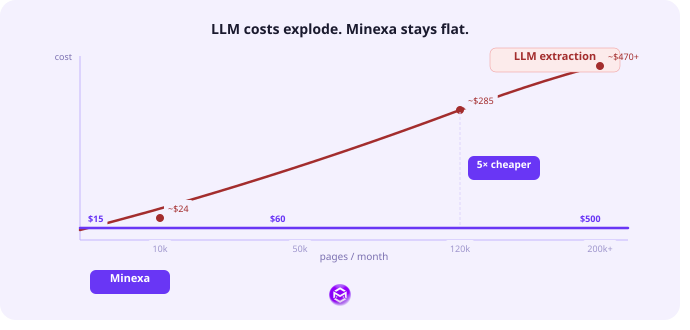
We priced 12 LLMs against the Minexa.ai API on the same scraped pages. Above a few thousand pages a month, every model costs more. On full HTML, the cheapest one costs 58 times more at 120,000 pages.
Cheapest LLM vs Minexa.ai at three monthly volumes
These use stripped HTML, the setup most favourable to LLMs. Full HTML makes every LLM number roughly 12 times larger. Minexa.ai doesn't move.
How the numbers were measured
Same pages, same job, extraction step only. If you're going to trust a comparison, you should know what's in it.
Scraped from live sites: job listings, ecommerce product pages, property results, reviews, search results and hotel booking pages.
Stripped HTML (scripts, styles and attributes removed) averaged 38,965 tokens. Full DOM-rendered HTML with whitespace cleaned averaged 572,739 tokens.
Enough for a typical structured JSON record from one page.
Getting the HTML costs the same whichever extractor you use, so only extraction is compared. On Minexa.ai, 1 credit equals 1 page, and pricing has no token component.
Stripped HTML: 38,965 input tokens per page
Sorted from cheapest to most expensive model. The last column shows how many times more each one costs than Minexa.ai Startup ($60) at 120,000 pages.
| Extractor | Per page | 10,000 pages | 120,000 pages | 2,000,000 pages | vs Minexa.ai at 120k |
|---|---|---|---|---|---|
| GPT-5 nano | $0.0024 | $24 | $285 | $4,700 | 4.75× |
| GPT-4.1 nano | $0.0043 | $43 | $516 | $8,600 | 8.6× |
| Gemini Flash Lite | $0.0043 | $43 | $516 | $8,600 | 8.6× |
| GPT-4o-mini | $0.0064 | $64 | $773 | $12,900 | 12.9× |
| Mistral Small 2 | $0.0097 | $97 | $1,164 | $19,400 | 19.4× |
| GPT-5 mini | $0.0117 | $117 | $1,410 | $23,500 | 23.5× |
| Mistral Medium 2 | $0.0195 | $195 | $2,340 | $39,000 | 39× |
| Claude Haiku 4.5 | $0.0440 | $440 | $5,280 | $88,000 | 88× |
| Mistral Large 2 | $0.0585 | $585 | $7,020 | $117,000 | 117× |
| GPT-5 | $0.0587 | $587 | $7,040 | $117,400 | 117× |
| GPT-4o | $0.1074 | $1,074 | $12,890 | $214,800 | 215× |
| Claude Sonnet 4.6 | $0.1319 | $1,319 | $15,820 | $263,700 | 264× |
| Minexa.ai Personal | $0.0015 | $15 | n/a | n/a | |
| Minexa.ai Startup | $0.0005 | $60 | $60 | n/a | 1× |
| Minexa.ai Business | $0.00025 | $500 | $500 | $500 |
Minexa.ai figures are flat monthly plan prices. Personal includes 10,000 credits, Startup 120,000 and Business 2,000,000. Extra credits are bought in packs once you go past the included amount.
Full HTML: 572,739 input tokens per page
This is what you send when you don't want to write preprocessing that might strip out the data you need. LLM token counts jump about 15 times. The Minexa.ai price stays exactly the same.
| Extractor | Per page | 10,000 pages | 120,000 pages | 2,000,000 pages | vs Minexa.ai at 120k |
|---|---|---|---|---|---|
| GPT-5 nano | $0.0290 | $290 | $3,480 | $58,000 | 58× |
| GPT-4.1 nano | $0.0584 | $584 | $7,000 | $116,700 | 117× |
| Gemini Flash Lite | $0.0584 | $584 | $7,000 | $116,700 | 117× |
| GPT-4o-mini | $0.0860 | $860 | $10,320 | $172,000 | 172× |
| GPT-5 mini | $0.1451 | $1,451 | $17,410 | $290,200 | 290× |
| Mistral Small 2 | $0.1455 | $1,455 | $17,460 | $291,000 | 291× |
| Mistral Medium 2 | $0.2925 | $2,925 | $35,100 | $585,000 | 585× |
| Claude Haiku 4.5 | $0.5840 | $5,840 | $70,080 | $1,168,000 | 1,168× |
| GPT-5 | $0.7259 | $7,259 | $87,100 | $1,451,800 | 1,452× |
| Mistral Large 2 | $0.8775 | $8,775 | $105,300 | $1,755,000 | 1,755× |
| GPT-4o | $1.3302 | $13,302 | $159,620 | $2,660,400 | 2,660× |
| Claude Sonnet 4.6 | $1.7332 | $17,332 | $207,980 | $3,466,400 | 3,466× |
| Minexa.ai Personal | $0.0015 | $15 | n/a | n/a | |
| Minexa.ai Startup | $0.0005 | $60 | $60 | n/a | 1× |
| Minexa.ai Business | $0.00025 | $500 | $500 | $500 |
Costs assume the model can take the whole page in one request. Most can't: models with context windows below roughly 600K tokens need to truncate or chunk the page, which adds code and can drop data without any error.
The honest break-even point
The Minexa.ai Personal plan is a $15 monthly floor, so at very small volumes a nano model costs less. GPT-5 nano on stripped HTML is $0.0024 a page, which crosses $15 at about 6,250 pages a month. GPT-4.1 nano and Gemini Flash Lite cross it at about 3,500.
On full HTML, GPT-5 nano passes $15 at around 520 pages.
Above those points, the gap grows with every page because LLM cost is linear in tokens and Minexa.ai cost is a flat plan.
- A one-off job of a few hundred stripped pages: a nano model is fine.
- A recurring pipeline in the thousands or more: Minexa.ai costs less at every volume tested.
- Any volume on full HTML: Minexa.ai, by 19× to over 1,000× at 10,000 pages.
Pages a month where the cheapest LLM tested (GPT-5 nano, stripped HTML) stops being cheaper than Minexa.ai Personal.
Page size has no effect on Minexa.ai pricing, so a 40K-token page and a 570K-token page cost the same credit.
Costs the tables leave out
Token prices are the visible part. A production LLM extraction pipeline also pays for the work around each call.
Retries and validation
Outputs vary between runs and can contain values that aren't on the page, so pipelines add schema checks and retry logic. A team tracking 80,000 product pages with GPT-5 nano paid about $230 a month once around 20% retry overhead was included. The same workload ran on Minexa.ai Startup for $60.
Preprocessing you have to maintain
Stripping HTML cuts tokens but can remove markup holding the data you need. Capping context instead can cut a page mid-content. Neither option shows an error when data goes missing.
Throughput
An LLM has to read and interpret each page before extracting anything. Minexa.ai extracts from the DOM in hundreds of milliseconds to a few seconds per page, roughly 50 to 200 times faster, in parallel up to your plan's thread limit.
Wrong values that look right
On product pages with a sale price and a crossed-out original price, an LLM can put one under the other's field. Minexa.ai binds each column to a specific DOM element, so missing data returns null and a page that no longer matches its scraper returns an explicit error.
Run the same comparison on your own HTML
If you already fetch pages with your own stack, proxies or another scraping API, you can compare like for like. Minexa.ai runs extraction only on HTML you've stored, at 1 credit per page.
- Open one of your target pages in the Minexa.ai Chrome extension and create a scraper in List or Detail mode. The AI checks thousands of selector combinations and picks the most stable ones. This takes a few minutes, once.
- Click API Request and choose the extract-only config for HTML you already have. The extension generates the exact request body for your scraper.
- Put your stored HTML URLs in
file_urls, the matching original pages inurls, and send it to the Minexa.ai API.
If you'd rather have the Minexa.ai API fetch pages too, pages that need JavaScript rendering, residential proxies or stronger anti-bot handling use more credits. That's fetching cost, which an LLM pipeline pays separately as well.
# POST https://api.minexa.ai/data/
# headers: {"Content-Type": "application/json", "api-key": "YOUR_KEY"}
{
  "scraping": {"js_render": false, "proxy": "verified"},
  "file_urls": [
    "https://9343.cloudfront.net/html-of-given-url-1.html",
    "https://9343.cloudfront.net/html-of-given-url-2.html"
  ],
  "urls": [
    "https://original-site.com/page-1",
    "https://original-site.com/page-2"
  ]
}
Each urls entry maps 1-to-1 to a file_urls entry so every extracted row traces back to its source page.
Which plan matches your volume
All plans include unlimited websites. Credits are monthly and don't carry over.
Personal
- 10,000 credits
- 3 threads
- 100 scrapers
Startup
- 120,000 credits
- 10 threads
- 500 scrapers
Business
- 2,000,000 credits
- 100 threads
- 5,000 scrapers
Put an LLM on top of your data, not in your extraction loop
Train a scraper once, send pages to the Minexa.ai API, and get the same JSON from the same page on every run, at a flat price per page.
Building agents or RAG on scraped data? Read why web scraping AI agents need dependable data before clever reasoning.